




























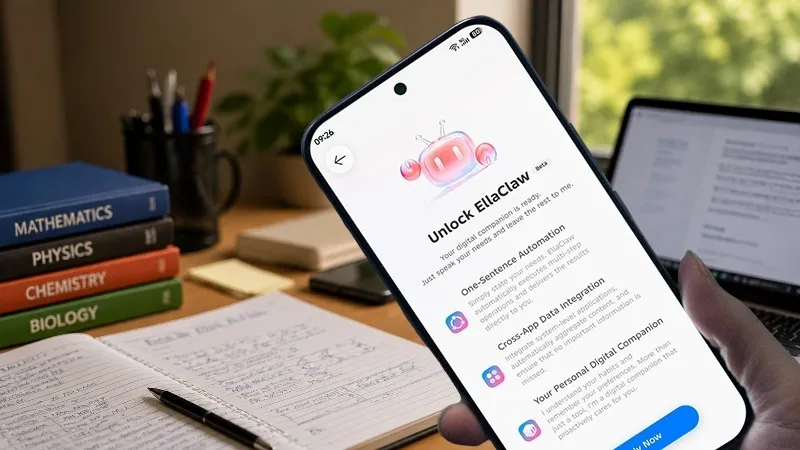

TECNO is expanding the role of its Ella artificial intelligence assistant beyond productivity, positioning the platform as a digital learning companion designed to help students, parents and educators across Africa access education support directly from their smartphones.
The company says Ella’s education-focused features are built to address everyday learning challenges by offering step-by-step assistance with schoolwork, research organisation, document scanning and video summarisation, while optimising the experience for entry-level smartphones commonly used across the continent.
The latest push comes as smartphone-based learning continues to gain momentum in Kenya, where mobile devices have become an important source of educational content both inside and outside the classroom.
Backing TECNO’s strategy is a March 2026 report by technology research firm Omdia, AI Roadmap for Smartphone Vendors in Africa’s Emerging Markets, which identified the company as pursuing a localisation strategy tailored to African users. According to the report, TECNO has developed AI models trained on African languages, including Swahili and Hausa, while optimising the technology to run efficiently on affordable devices.
TECNO says one of Ella’s key education features is a student mode that guides learners through mathematical problems using step-by-step explanations instead of simply providing answers. The company argues that the approach is intended to improve understanding rather than encourage shortcuts during learning.
Beyond assisting students, Ella also includes tools aimed at parents. TECNO says the feature is designed to help parents better understand school concepts and support their children’s learning at home, particularly as many families continue adapting to Kenya’s Competency Based Curriculum.
The AI assistant also introduces Mindhub, a feature that enables users to organise notes, summarise information and retrieve previously saved research materials. TECNO says the tool is intended to help students manage coursework more efficiently by reducing the time spent searching for information collected from multiple sources.
Other education-focused capabilities include document scanning and AI-powered video summarisation. According to the company, students can digitise handwritten notes using their smartphones and quickly review the contents of educational videos before deciding whether to watch them in full.
TECNO says these features are designed to improve accessibility by reducing dependence on additional software and expensive computing devices, allowing more students to access AI-powered learning tools from smartphones they already own.
Omdia’s report suggests that localisation remains one of the biggest differentiators among smartphone manufacturers targeting Africa. The research notes that factors such as mobile data costs, inconsistent internet connectivity and the diversity of local languages continue to influence how AI services are adopted across the region. TECNO’s strategy focuses on addressing those challenges through lightweight AI models capable of running directly on compatible devices.
The report also highlights the company’s position in the African smartphone market, noting that Transsion Holdings, TECNO’s parent company, accounted for an estimated 48 percent of smartphone shipments across Africa in 2025. That market presence, according to Omdia, gives the company an opportunity to introduce AI-powered services to millions of users through devices already in circulation.
While AI-powered learning tools are not intended to replace teachers or formal education, TECNO says they can complement classroom instruction by providing students with on-demand support outside school hours. The company believes embedding the technology directly into smartphones could make digital learning more accessible, particularly for learners who rely on mobile devices as their primary connection to educational resources.
The expansion of Ella reflects a broader shift among smartphone manufacturers as they increasingly compete on AI capabilities rather than hardware alone. For TECNO, the focus remains on delivering those capabilities through features designed specifically for the realities of African users, where affordability, connectivity and localisation continue to shape the adoption of new technologies.
