





































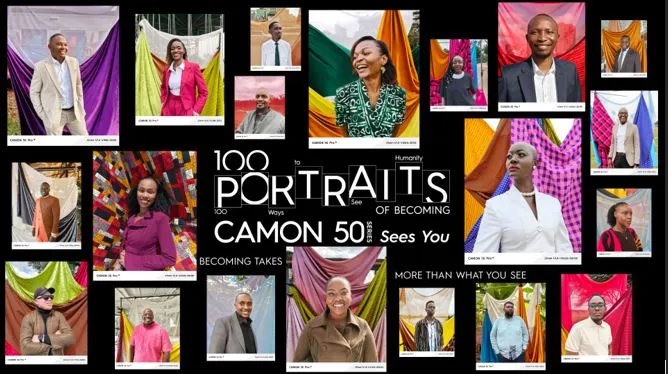

TECNO has concluded the Kenyan chapter of its 100 Portraits of Becoming project, a global portrait initiative created with Brazilian artist and photographer Angélica Dass.
The Kenyan chapter features 20 people photographed using the TECNO CAMON 50 Ultra, capturing their faces across different complexions, environments and everyday lighting conditions.
At the centre of the project is Universal Tone 3.0, TECNO’s multi-skin-tone imaging technology designed to improve the representation of different complexions, skin textures and lighting conditions.
Rather than focusing solely on camera specifications, the project connects the technology to the people being photographed and the stories behind their lives and work.
The portraits form part of the wider CAMON 50 Sees You campaign, which explores the idea that what appears in a photograph represents only part of a person’s story.
The accompanying interviews look at the choices, setbacks and work behind the individuals featured, under the campaign message “Becoming Takes More Than You See.”
Universal Tone 3.0 and skin-tone representation
Universal Tone 3.0 combines a multi-skin-tone colour reference system, skin-tone data and AI-powered imaging engines to improve how different complexions are represented.
According to TECNO, the technology is not intended to make every face appear the same or impose a particular beauty standard. Instead, it is designed to preserve the colour, texture and characteristics that make individuals recognisable as themselves.
The Kenyan project puts that approach into everyday settings, where photography can involve strong daylight, shade, office lighting, mixed indoor conditions and group portraits.
By photographing people in these environments rather than relying solely on controlled studio conditions, the project demonstrates how the technology is intended to perform across different real-world situations.
The Kenyan stories behind the portraits
The 20 Kenyans featured in the project include entrepreneurs, creators and community builders whose work is connected to businesses, communities and new opportunities.
One of them is Mutua Alex Muli, co-founder of Goshen Farm, who chose to remain in his hometown and build opportunities through agriculture.
After seeing family farmers lose crops, Muli developed export channels and used digital platforms to connect small-scale farmers with markets, helping turn produce that could otherwise have gone to waste into income for the community.
“When everyone said leave, I stayed. I wanted to prove that there was something worth building here,” Muli said.
The collection also features Jelimo Cheboi, co-founder of GirlSkate Nairobi, who has helped create a supportive space for female skateboarders.
Her story focuses not only on skateboarding but also on creating an environment where girls and women can participate, learn and develop a sense of belonging.
“There was no place for us, so we created one,” Cheboi said.
Other participants include Anita Mbithe, founder of Brushes By Mbithee, Beauty and Hair, and Brian Muchiri, founder of Boy in The Wheelchair.
Their stories bring additional perspectives on entrepreneurship, creativity, disability and representation.
Angélica Dass and the question of representation
The project is being led artistically by Angélica Dass, whose portrait photography examines identity, diversity and representation.
In 100 Portraits of Becoming, Dass provides the artistic direction and human connection behind the portraits, while TECNO contributes the imaging technology.
The collaboration therefore brings together two aspects of portrait photography: how people are represented and how accurately cameras can reproduce their appearance.
Kenya marks the beginning of a planned two-year project that will produce 100 portraits across five countries: Kenya, the Philippines, Saudi Arabia, Türkiye and Brazil.
Each chapter will document people in the environments where they live and work, creating a wider collection of personal stories and identities.
For TECNO, the Kenyan chapter gives the CAMON 50 Sees You campaign a local dimension while positioning Kenya at the starting point of a broader global creative and technology project.
The initiative combines smartphone imaging with portrait storytelling to explore a simple question: how can technology represent people more accurately while still leaving room for the stories that a photograph cannot capture?
